SAVE UP TO 10% TODAY! - PROMO CODE: UGOTIT10



Stop Operating Under the Radar: Sole Proprietor vs. LLC vs. Corp
Don't risk your personal savings on a great business idea. Many founders fall into the "accidental sole proprietor" trap without realizing the legal risks. Discover how to shield your personal assets and pick the right structure for your startup.
U GOT IT
5/24/20264 min read
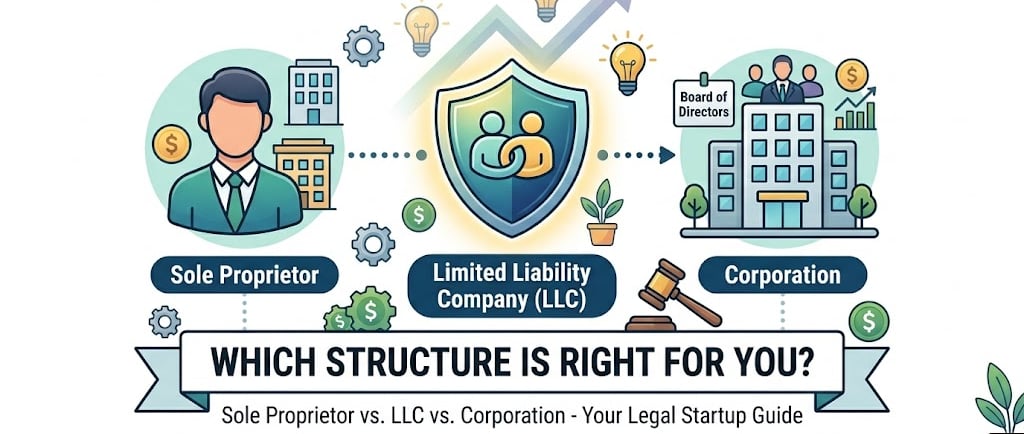
Sole Proprietor vs. LLC vs. Corporation: Which is Right for You?
Congratulations! You have a fantastic business idea, and you’re ready to bring it to life.
But before you print business cards or launch your website, you need to make one of the most critical decisions of your entrepreneurial journey: choosing your business structure.
Many new entrepreneurs fall into a dangerous trap. They start selling a product or providing a service, assuming they are just "testing the waters." What they don't realize is that by doing this, they have automatically become a Sole Proprietor in the eyes of the law. Operating this way without understanding the risks is like driving a car without insurance—it works fine until you hit a bump in the road.
Let’s pull back the curtain on the three most common business structures so you can confidently pick the right one for your startup.
1. The Accidental Entity: Sole Proprietorship
According to the IRS, a sole proprietor is someone who owns an unincorporated business by themselves.
How it’s formed: You don't have to file formal paperwork to create it. If you freelance, bake cookies for profit, or consult on the side, you are a sole proprietor by default.
Taxes: The IRS uses "pass-through" taxation. The business itself doesn't pay taxes; instead, the business profits and losses "pass through" to your personal tax return (usually filed on a Schedule C with your Form 1040).
⚠️ The Hidden Risk: Unlimited Personal Liability
Because a sole proprietorship is so easy to start, many entrepreneurs stay in this phase way too long without realizing the danger.
In a sole proprietorship, you and your business are legally the exact same entity. There is no wall between your personal life and your business life.
If your business gets sued because a client trips and falls, or because a product fails, your personal assets (your savings, your car, and even your home) are at risk to pay off that debt.
2. The Shield: Limited Liability Company (LLC)
If you want protection but don't want to drown in corporate paperwork, the Limited Liability Company (LLC) is often the sweet spot for startups.
How it’s formed: You formally file a document—usually called Articles of Organization—with your state's business filing office and pay a registration fee.
The "Shield" Benefit: An LLC creates a legal wall between your personal assets and your business liabilities. If the LLC goes into debt or faces a lawsuit, only the money and assets owned by the business are on the line. Your personal bank accounts and house are generally safe (a concept known as "limited liability").
Taxes: By default, the IRS taxes a single-member LLC exactly like a sole proprietorship (pass-through taxation). However, LLCs are highly flexible. As your business grows, you can actually ask the IRS to tax your LLC as a corporation if it saves you money on self-employment taxes.
💡 The Golden Rule of LLCs
To keep your liability shield active, you must keep your business and personal life completely separate. This means opening a dedicated business bank account and never mixing personal money with business expenses. If you mix them, a court can "pierce the corporate veil" and hold you personally responsible anyway.
3. The Heavyweight: Corporation (C-Corp or S-Corp)
A corporation is a completely independent legal entity owned by shareholders. It is the most complex structure, but it is necessary for specific types of businesses.
How it’s formed: You file Articles of Incorporation with your state, write bylaws, and issue stock to owners (shareholders).
Taxes: A standard corporation (C-Corp) faces what is called "double taxation." The corporation pays a 21% tax on its profits, and then shareholders pay taxes again on their personal returns when those profits are distributed as dividends.
S-Corporation Status: Small businesses can sometimes elect "S-Corp" status with the IRS. This allows profits to pass through to personal tax returns like an LLC, avoiding double taxation, while keeping the strict corporate structure.
🚀 Why choose a Corporation?
If you plan to pitch to venture capitalists, seek heavy angel investment, or eventually go public on the stock market, you must be a corporation. Investors prefer corporations because they can easily buy and sell shares of stock. However, corporations require massive upkeep, including holding annual shareholder meetings and keeping meticulous corporate minutes.
Which One is Right For You? A Simple Decision Framework
To figure out your next move, ask yourself these three questions:
What is my risk level? If you sell physical products, give professional advice, or hire employees, your risk is too high for a Sole Proprietorship. You need an LLC or Corporation.
Am I seeking outside investors? If you need venture capital to grow, start as a Corporation. If you are self-funding or taking standard bank loans, an LLC is usually better.
Can I handle the paperwork? If you want protection but don't want to deal with strict annual meetings and complex record-keeping, the LLC provides the best balance of safety and simplicity.
Choosing your structure isn't permanent—you can start as an LLC and convert to a corporation later as you scale. The most important step is to stop operating under the radar as an accidental sole proprietor if your business exposes you to real legal risks.
Ready to Take the Next Step?
Choosing your structure is only half the battle—the next step is bringing it to life. Depending on your time, budget, and comfort level with administrative paperwork, you have a few different paths forward:
The Do-It-Yourself Route: You can always file your own corporation directly by visiting your state's official business filing office. To find the right destination and see what it will cost, you can access our free list of corporate filing agencies and their respective fees our free list of corporate filing agencies and their respective fees across the country.
Are you launching in Texas? If you live in the Lone Star State, the process requires navigating specific state rules and documents via the Texas Secretary of State. To make this seamless, we have compiled a dedicated, step-by-step illustrated guideline on how to file your corporation successfully—Click here to get your Texas Bundle and fast-track your setup.
The Hands-Off Route: If you prefer to focus entirely on building your product rather than deciphering legal jargon, you can use a trusted 3rd-party provider. These specialized corporate formation services will handle the entire filing process, secure your EIN, and ensure your paperwork is correctly processed on your behalf.
Disclaimer: This blog post is for educational purposes only and does not constitute legal or tax advice. Always consult with a certified public accountant (CPA) or business attorney before making official entity decisions.
U GOT IT
Strategic resources and startup essentials designed for the modern founder.
Contact
Receive More Business Tips
© 2024. All rights reserved.